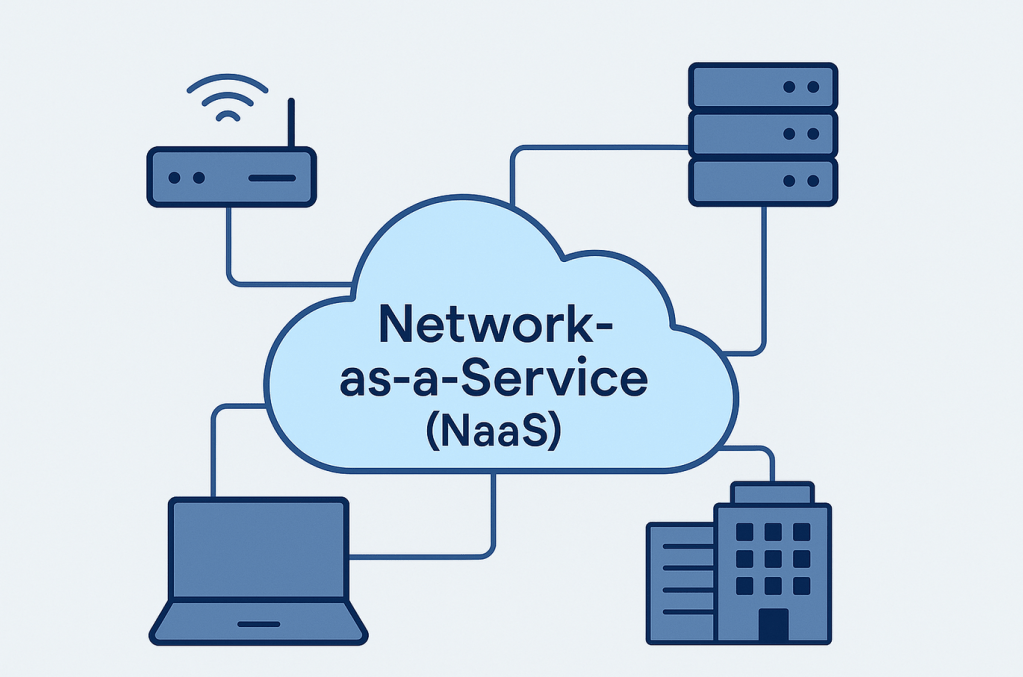
Modern businesses rely on networks that connect users, clouds, data centers, and devices across multiple regions and environments. But building and maintaining these networks traditionally required physical hardware, manual configuration, and constant upkeep — often slowing down innovation and increasing costs.
As organizations have shifted toward cloud computing, distributed workforces, and AI-driven applications, this old model has become increasingly difficult to manage. Network-as-a-Service (NaaS) emerged to solve that problem. It turns networking into a cloud-delivered service that’s scalable, flexible, and managed through software instead of hardware.
Understanding Network-as-a-Service
Network-as-a-Service (NaaS) delivers networking infrastructure — including routing, connectivity, and security — as a subscription-based service. Rather than buying routers, switches, and VPNs, companies consume networking resources on demand, similar to how they use cloud storage or compute.
NaaS was developed to reduce the cost and complexity of operating global networks. Traditional models required heavy up-front investments and long provisioning times. In contrast, NaaS enables businesses to deploy connectivity in minutes, scale instantly, and pay only for what they use.
By shifting from hardware ownership to service consumption, NaaS brings agility, automation, and operational efficiency to enterprise networking.
How Does Network-as-a-Service (NaaS) Work?
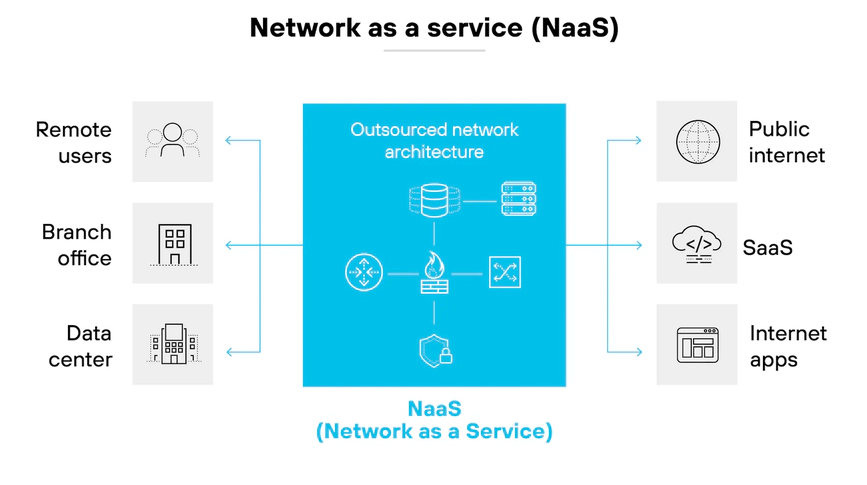
NaaS operates on a software-defined foundation. The provider manages the underlying infrastructure — including data centers, edge nodes, and transport links — while customers interact with the network through a centralized platform or API.
Here’s how it typically works:
- Subscription Model
The customer subscribes to networking services, such as branch connectivity, cloud access, or partner links. There’s no need to purchase hardware or maintain circuits directly. - Software-Defined Automation
Provisioning and configuration are handled through software. Policies, routes, and segmentation can be deployed through a management portal rather than through device-by-device commands. - Global Fabric
Providers maintain a distributed network fabric that connects enterprises, clouds, and partners through high-performance, encrypted links. Customers use this shared fabric rather than building their own global network. - Lifecycle Management
The provider is responsible for updates, performance optimization, and monitoring. IT teams focus on outcomes — ensuring secure, reliable connectivity — instead of maintaining hardware.
The result is a network that behaves more like a cloud service: agile, elastic, and consumption-driven.
Advantages vs. Challenges of NaaS
Advantages
- Speed and Agility: Connections can be deployed and adjusted within minutes rather than weeks.
- Reduced Capital Costs: Shifting from CapEx to OpEx lowers the financial barrier to scaling.
- Simplified Management: Providers handle maintenance, updates, and optimization.
- Scalability: The network grows or contracts as needed, following business demand.
- Enhanced Security and Visibility: Many NaaS solutions include encryption, segmentation, and built-in monitoring.
- Alignment with Cloud Models: NaaS integrates easily with cloud and SaaS ecosystems.
Challenges
- Integration with Legacy Networks: Existing WAN or MPLS setups may require migration planning.
- Vendor Dependency: Organizations must rely on provider uptime, SLAs, and compliance assurances.
- Cost Management: Consumption-based models can lead to unpredictable expenses if not monitored.
- Security Oversight: Even with built-in protections, organizations remain responsible for overall governance and policy alignment.
- Skill Adaptation: Teams may need to learn platform-based orchestration instead of traditional device management.
Graphiant’s Approach to NaaS
Graphiant takes the principles of Network-as-a-Service and extends them into a global data fabric designed for today’s AI-driven, distributed enterprise.
Its platform delivers any-to-any connectivity — linking branches, clouds, and partners through a stateless, SLA-based network. Unlike legacy VPN or SD-WAN models, Graphiant’s service operates as an encrypted, policy-driven fabric, integrating performance, governance, and compliance into the network itself.
Key aspects of Graphiant’s NaaS model include:
- Simplified Onboarding: On-demand provisioning eliminates the need for SD-WAN hardware or cross-connects.
- Integrated Governance: Data assurance and policy enforcement occur at the network layer, without decrypting traffic.
- AI-Ready Fabric: The network is designed to support data mobility, visibility, and performance for AI workloads.
- Elastic Economics: Customers pay for what they consume while maintaining enterprise-grade reliability.
Graphiant’s approach represents an interesting evolution of NaaS — moving from basic connectivity toward intelligent, governed networking for hybrid, multi-cloud, and AI environments.
In short
Network-as-a-Service is reshaping how organizations design and operate their networks. By treating connectivity as a flexible service rather than a fixed asset, businesses can adapt faster, reduce operational friction, and focus on delivering digital outcomes rather than maintaining infrastructure.
The future of networking is moving toward abstraction and automation — where governance, performance, and scalability are built directly into the fabric. Graphiant’s model exemplifies that future, showing how NaaS can serve as the foundation for a more adaptive, intelligent, and secure network architecture.
For those interested in networking, understanding NaaS isn’t just about staying current — it’s about recognizing how networking itself is transforming to match the pace of the cloud era.


Leave a Reply