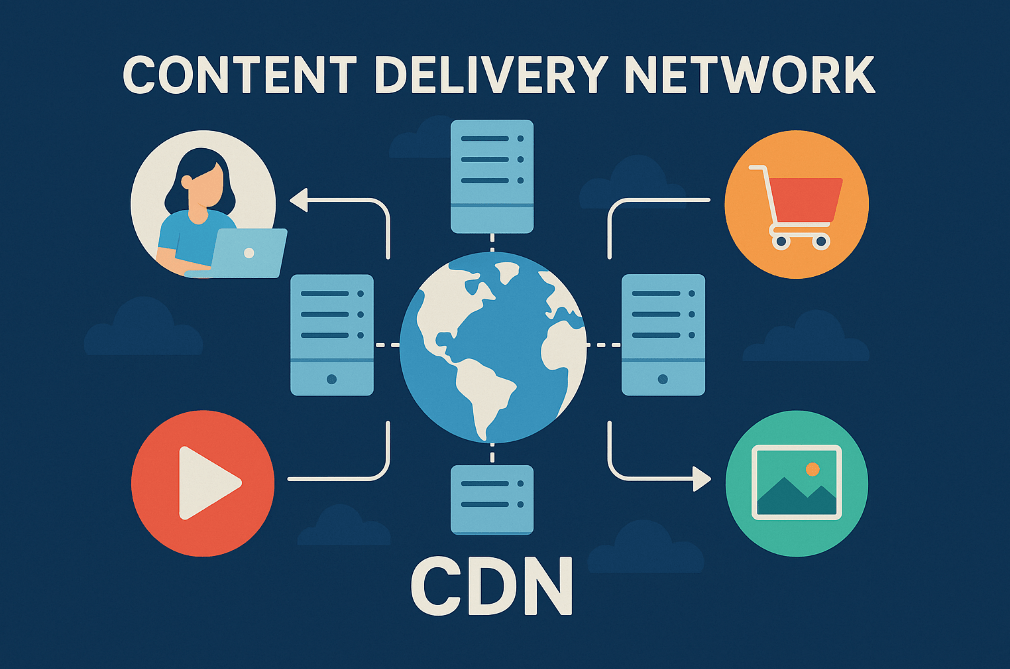
When you stream your favorite show, shop online, or scroll through social media, you probably aren’t thinking about where all that content is coming from. Behind the scenes, Content Delivery Networks (CDNs) play a huge role in making sure those videos load quickly, images display smoothly, and websites stay online—even when millions of people are accessing them at once.
In this post, we’ll cover the basics of CDNs, why they’re important, and some real-world examples of how they keep the internet running fast and reliably.
What Is a Content Delivery Network (CDN)?
At its core, a CDN is a network of servers spread out across the world that work together to deliver content to users more efficiently.
Instead of loading data (like a website, video, or image) directly from one central server—which could be located halfway across the globe—CDNs store cached versions of this content on multiple servers (called edge servers) located closer to users.
So when you click play on a Netflix show in your home, you’re not waiting for data from a server in California or New York. You’re getting that content from a nearby server, reducing delay (latency) and speeding up your experience.
Why CDNs Are Important
CDNs solve several common problems that arise with modern internet usage:
- Speed and Performance
- The closer the server is to the user, the faster the content loads.
- For example, an e-commerce site using a CDN will load faster for global customers, reducing cart abandonment.
- Scalability
- During traffic spikes (think Black Friday shopping, viral videos, or major news events), CDNs handle the surge by distributing traffic across multiple servers instead of overwhelming one origin server.
- Reliability
- If one server goes down, requests are automatically rerouted to another server in the network. This redundancy keeps websites online even during failures.
- Security
- Many CDNs provide DDoS protection, filtering malicious traffic before it ever reaches the origin server.
Real-World Examples of CDNs in Action
- Netflix
- Netflix operates its own CDN called Open Connect, with servers placed inside ISPs worldwide. This ensures smooth streaming without buffering, even when millions are watching at once.
- YouTube
- Google uses a global CDN infrastructure to deliver videos. That’s why a video loads instantly in different countries despite the enormous scale of users.
- E-Commerce Giants (Amazon, Shopify, etc.)
- Retailers rely on CDNs to ensure fast product page loads for customers around the world, which directly impacts sales.
- Cloudflare and Akamai
- These companies are leading CDN providers, powering millions of websites. Cloudflare, for example, doesn’t just improve performance—it also blocks malicious traffic and provides caching for faster access.
Why This Matters for Businesses and IT
For businesses, a CDN isn’t just about speed—it’s about user experience, security, and uptime.
- A faster website improves SEO rankings and keeps customers engaged.
- Reliable delivery ensures global accessibility.
- Built-in security helps protect from cyber threats.
Content Delivery Networks might not be visible to the average user, but they form the backbone of the modern internet. Whether it’s streaming your favorite show, buying shoes online, or reading this very blog, chances are a CDN is working behind the scenes to make sure everything loads smoothly, securely, and reliably.
 Ctrl+Alt+Route
Leave a comment