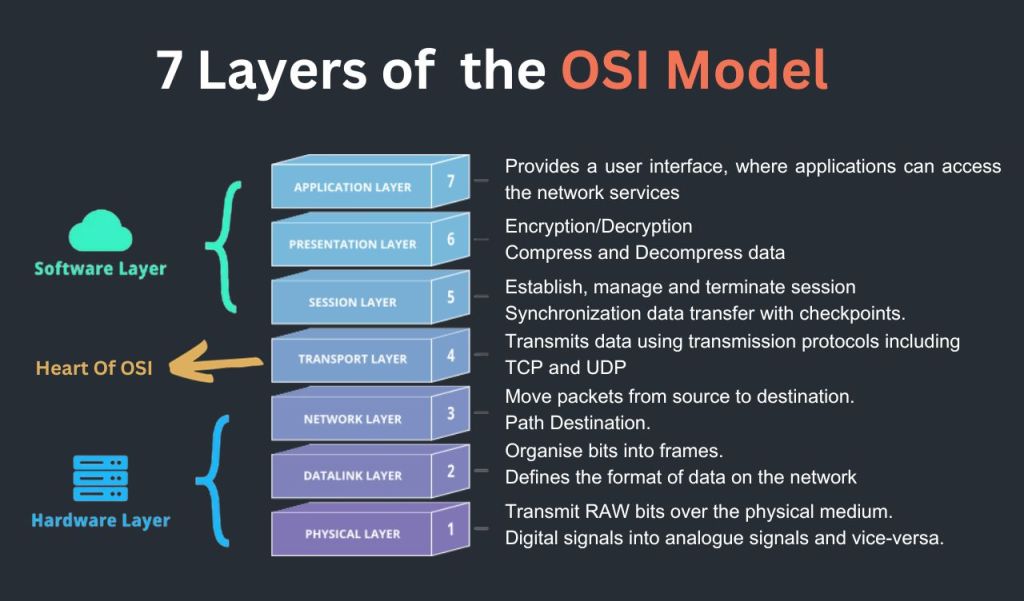
When learning about networking, one of the foundational concepts is the OSI Model. It’s framework that standardizes the functions of network communications into seven distinct layers. Each layer has a specific role in ensuring successful communication between devices across a network. In this article, we’ll walk through each layer, from Layer 7 down to Layer 1, and break down their key functions.
Layer 7: Application Layer
The Application Layer in the OSI model is the top layer and serves as the interface between user applications and the network. It provides services that allow applications to access network resources and exchange data, essentially acting as the window for applications to communicate with each other
Key functions of the Application Layer include:
- Establishing the availability of intended communication partners.
- Synchronizing and agreeing on communication procedures, such as error recovery and data integrity control.
Examples: Web browsers, email clients, FTP clients.
Layer 6: Presentation Layer
The Presentation Layer ensures that the data sent from the Application Layer of one device can be read by the Application Layer of another device. In short, it translates, encrypts, and compresses data as needed.
Key functions include:
- Translating data between different data formats using a common format (for example, translating between different encoding schemes).
- Managing encryption and compression.
Examples: Data encryption (SSL/TLS), character encoding (ASCII, Unicode).
Layer 5: Session Layer
The Session Layer is responsible for establishing, managing, and terminating sessions between two communicating hosts. It keeps data streams separate and organizes dialogue between systems.
Key functions include:
- Synchronizing communication sessions.
- Managing multiple sessions simultaneously, which is especially important for services like web servers handling many users.
- Providing efficient data transfer, class of service (CoS) functions, and reporting upper-layer exceptions.
Examples: APIs, sockets, Remote Procedure Calls (RPC).
Layer 4: Transport Layer
The Transport Layer defines how data is segmented, transferred, and reassembled between end devices. It plays a crucial role in providing reliable or unreliable delivery, depending on whether TCP or UDP is used.
Key functions include:
- Segmenting large data files into smaller, manageable segments.
- Ensuring complete data transfer.
- Utilizing port numbers to manage multiple connections.
Examples: TCP (Transmission Control Protocol), UDP (User Datagram Protocol).
Layer 3: Network Layer
The Network Layer is primarily concerned with the delivery of packets from source to destination across multiple networks.
Key functions include:
- Logical addressing, most notably through source and destination IP addresses.
- Path selection and routing using routers.
Examples: IP (Internet Protocol), routers, Layer 3 switches.
Layer 2: Data-Link Layer
The Data-Link Layer defines how data is formatted for transmission and how physical addressing is handled, typically using MAC addresses.
Key functions include:
- Managing source and destination Layer 2 addresses.
- Controlling how devices on a network gain access to the media.
- Error detection and correction to ensure reliable data delivery.
Examples: Ethernet, switches, PPP (Point-to-Point Protocol).
Layer 1: Physical Layer
The Physical Layer deals with the hardware elements involved in networking—the tangible components that transmit data as electrical, optical, or radio signals.
Key functions include:
- Defining specifications for cables, connectors, voltage levels, and data rates.
- Establishing, maintaining, and deactivating the physical connection between devices.
Examples: Cables (Ethernet, fiber optic), network interface cards, hubs.
 Ctrl+Alt+Route
Leave a comment