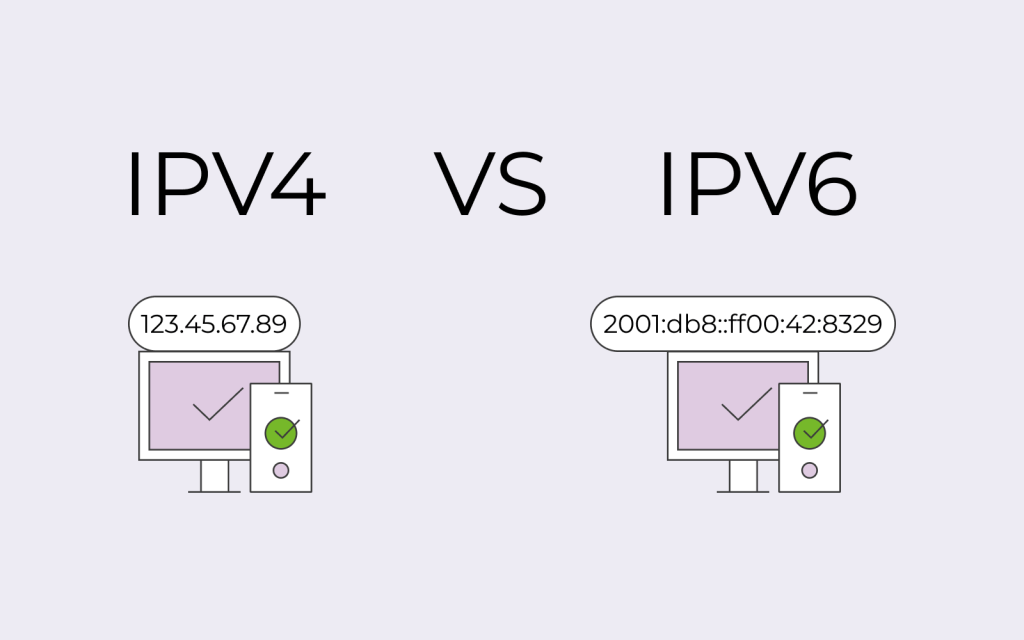
As we continue to move into an increasingly digital world, understanding the difference between IPv4 and IPv6 is becoming more crucial than ever. These two layer 3 protocols are responsible for assigning unique IP addresses to devices on the internet, ensuring that data is routed to the correct destination. But as the number of devices connecting to the internet grows, IPv4’s limitations are becoming apparent. This is where IPv6 steps in.
What is IPv4?
IPv4 (Internet Protocol version 4) is the fourth version of the Internet Protocol, and it has been the standard for addressing devices on the internet since the early days of the internet. IPv4 addresses are 32-bit numbers, which means they consist of four sets of numbers (each ranging from 0 to 255), separated by periods.
For example, an IPv4 address looks like this: 192.168.1.56
This gives us a total of approximately 4.3 billion unique addresses, which, at the time of its creation was thought to be more than enough. However, as the number of connected devices has exploded (such as smart phones, smart TVs, IoT devices, etc.), we’ve run out of IPv4 addresses, creating the need for a new system,
What is IPv6?
IPv6 (Internet Protocol version 6) is the next generation of IP address, designed to overcome the limitations of IPv4. IPv6 uses a 128-bit address, which allows for an incredibly larger number of unique IP addresses. IPv6 addresses are written as eight groups of four hexadecimal characters (0-9 and a-f), separated by colons.
For example, an IPv6 address looks like this: 2001:0db8:85a3:0000:0000:8a2e:0370:7334
With IPv6, the total number of available addresses is mind-boggling–about 340 undecillion (yes, that’s a legitimate number). This practically guarantees that we’ll never run out of addresses again.
Key Differences Between IPv4 and IPv6
Address format
- IPv4 uses a 32-bit address, written as four decimal numbers separated by periods (e.g., 192.168.1.25).
- IPv6 uses a 128-bit address written as eight groups of four hexadecimal numbers separated by colons (e.g.,2001:0db8:85a3:0000:0000:8a2e:0370:7334).
Address Space
- IPv4 can accommodate about 4.3 billion addresses, which have already been exhausted due to rapid growth of internet-connected devices.
- IPv6 can accommodate about 340 undecillion addresses, which is more than enough for the foreseeable future.
Header Size
- IPv4 has a header size of 20 bytes.
- IPv6 has a header size of 40 bytes, but it is more efficient due to the simplified fields, and it’s designed to support higher speeds and more advanced features.
Address Configuration
- IPv4 typically uses a manual configuration, statically assigning the address or a DHCP (Dynamic Host Configuration Protocol) server to automatically obtain an address.
- IPv6 supports stateless address autoconfiguration (SLAAC), which means devices can automatically generate their own IP addresses based on the network they are connected to, without needing a DHCP server.
Routing Efficiency
- IPv4 has complex and less efficient routing due to the large number of routing tables that have to be maintained by ISPs and network devices.
- IPv6, with it’s larger address space and simplified routing, is much more efficient. It reduces the need for NAT (Network Address Translation), which is often used with IPv4 to cope with address shortages.
Security
- IPv4 has security features such as IPsec (Internet Protocol Security), these features unfortunately are not native and were added later on.
- IPv6 has security mechanisms integrated into it, with IPsec being a mandatory part of the protocol. This makes it a more secure option for modern networks.
Network Address Translation (NAT)
- IPv4, due to the limited number of addresses, often relies on NAT to share a single public IP address among multiple devices on a private network.
- IPv6 does not need to use NAT because of the vast number of available addresses. Each device can have a unique public IP address, improving the simplicity and reliability of the network.
 Ctrl+Alt+Route
Leave a comment